Does your tree need to come down—or does it simply need a good trimming?
That’s a common question for homeowners when a tree becomes overgrown, develops dead branches, grows too close to a structure, or starts showing signs of damage. While pruning can correct many tree problems, there are situations where removal is the safer and more appropriate choice.
Understanding the difference can help you make a more informed decision about your trees and your property.
When Is Tree Trimming the Better Option?
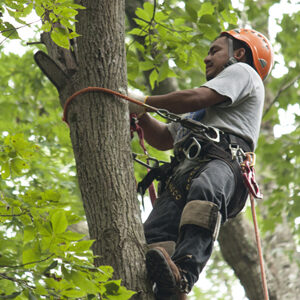 Tree trimming, also called pruning, is often appropriate when the tree is generally healthy but has branches that need to be removed or redirected.
Professional tree trimming may be recommended when you have:
- Dead or broken branches that could fall
- Branches growing toward your roof or other structures
- Overgrown limbs extending over driveways, walkways, or other areas
- Branches rubbing against each other or creating weak points
- Uneven or excessive growth affecting the tree’s structure
- Branches interfering with utility lines or other property features
Strategic pruning can improve clearance, remove hazardous limbs, and help maintain the tree’s overall structure while allowing you to preserve a healthy, established tree.
However, trimming isn’t simply a matter of cutting away as much growth as possible. Removing too much of a tree’s canopy can create additional stress and potentially contribute to future problems. Professional pruning should be based on the tree’s species, condition, structure, and location.
When Does a Tree Need to Be Removed?
Tree removal becomes a consideration when a tree has significant structural or health problems that cannot reasonably be corrected through pruning.
Signs that removal may be necessary include:
Significant Trunk Decay
Extensive decay or hollowing in the trunk can compromise a tree’s structural integrity. While some internal decay doesn’t automatically mean a tree must be removed, significant deterioration warrants professional evaluation.
Major Cracks or Splits
Large cracks in the trunk or major branches can indicate serious structural weakness. Cracks that extend through significant portions of the tree may increase the potential for branch or trunk failure.
Severe Root Damage
A tree depends on its root system for both water and structural support. Major root damage, especially near the trunk, can make a tree unstable even when the canopy still appears healthy.
Extensive Deadwood or Dieback
A few dead branches are often addressed through pruning. Extensive deadwood or widespread canopy dieback, however, can indicate a more serious underlying problem.
Severe Storm Damage
Lightning, hurricanes, strong winds, and other storms can leave trees with broken limbs, split trunks, or damaged roots. Some storm-damaged trees can be saved through pruning, while others may be too structurally compromised to remain safely.
Significant Leaning or Instability
Not every leaning tree is dangerous. Some trees naturally grow at an angle. However, a tree that is newly leaning, developing soil movement around its roots, or showing other signs of instability should be professionally evaluated.
What If the Tree Is Too Close to Your House?
A tree growing close to a home doesn’t automatically mean it needs to be removed.
The important questions are the tree’s health, structure, size, growth pattern, and what could be affected if a branch or the tree itself were to fail.
In some situations, selective pruning can provide adequate clearance from the roof or structure. In others, removal may make more sense if the tree is unhealthy, structurally compromised, or positioned where failure could cause significant damage.
North Raleigh Tree Service has previously covered this topic in more detail in How Close Can a Tree Be to Your House Before It Becomes a Risk?.
Don’t Assume Aggressive Trimming Will Solve a Dangerous Tree
One common misconception is that a dangerous tree can simply be cut back until it becomes safe.
Unfortunately, removing large portions of a tree’s canopy doesn’t necessarily correct serious structural problems. In some cases, aggressive pruning can create additional stress or leave a tree with poor structure and large pruning wounds.
If the underlying issue involves major decay, root damage, a compromised trunk, or severe structural weakness, professional evaluation is important before deciding how much of the tree should be removed.
What Happens During a Professional Tree Assessment?
When determining whether a tree should be trimmed or removed, a professional tree service should consider more than just what the tree looks like from the ground.
An assessment may consider:
- Overall tree health
- Trunk condition and signs of decay
- Major branch structure
- Dead or damaged limbs
- Root flare and visible root conditions
- Lean and signs of movement
- The tree’s location and surrounding structures
- Potential targets if the tree or a major limb were to fail
- Whether pruning could reasonably address the identified risks
The goal isn’t necessarily to remove the tree. In many cases, the best solution is to preserve the tree through appropriate pruning. When removal is recommended, however, it should be because the tree’s condition or location makes keeping it an unreasonable risk.
Choosing the Right Solution for Your Raleigh-Area Trees
Tree trimming and tree removal serve very different purposes. Trimming is generally about maintaining and managing a healthy tree, while removal is appropriate when a tree has become too hazardous, unhealthy, or structurally compromised to safely remain in place.
The right decision depends on the individual tree and its surroundings.
North Raleigh Tree Service provides professional tree trimming, tree removal, storm cleanup, crane services, and other tree care services for homeowners throughout Raleigh and the surrounding communities.
If you’re unsure whether a tree needs to be trimmed or removed, having it evaluated by an experienced tree service can help you understand your options before making a decision.
Contact North Raleigh Tree Service to schedule an evaluation and determine the best approach for your trees and property.